

Global Love Report – October 28th, 2026 | English summary by Margaret
Many singles seeking serious relationships want more personalized, human, and discreet guidance throughout their dating journey. This has increased demand for professional matchmaking services, also creating a great opportunity for aspiring matchmakers who want to open a matchmaking agency in France.
To achieve success, there are three pillars that are important:
- Clear positioning
- A well-chosen service area
- Strict compliance with regulations
These are the true differentiators in the sector. And here’s a step-by-step guide to opening a matchmaking agency in France.
Choose Your Niche and Target Clientele
What you need to do first is choose your niche. You could run a general matchmaking agency open to all eligible singles or focus on a specific niche, such as seniors, high-end clients, a particular community, or LGBTQ+ singles. Alternatively, you could position your agency as a premium service offering fully bespoke matchmaking. This choice shapes your pricing, your marketing, and the kind of location you’ll need later.
Conducting Market Research
What you need to do next is check your market. Look at local demand and conduct competitor mapping that includes both offline matchmaking agencies and online dating sites. Then, define your target market and your service area. France, for example, has around 400 recognized matchmaking agencies, nearly three quarters of them franchises, serving an estimated 18 million single people nationwide. Understanding these market conditions can help you assess whether your business idea is viable before making any investment.
Build a Business Plan
Once your research is done, what you need to do is put it into a business plan. This turns your concept into numbers. It combines your market findings with a three-year financial forecast and your sales and marketing approach, and it’s what convinces a bank or franchise network to back you up. Pay close attention to cash flow, since revenue here builds up contract by contract and the first few months tend to be slow, so plan a cash buffer to get through that early stretch.
Settle on a Business Structure (Statut Juridique)
Your business structure depends on how big you want to go. If you want to test the waters first, to lower the risk, starting with a micro-enterprise or sole proprietorship is enough to get started. If you’re planning something bigger, one that can bring in partners and reassure stakeholders, a SARL (Société à Responsabilité Limitée, Limited Liability Company) / EURL (Entreprise Unipersonnelle à Responsabilité Limitée, Single-Member Limited Liability Company) or SAS (Société par Actions Simplifiée, Simplified Joint-Stock Company) / SASU (Société par Actions Simplifiée Unipersonnelle, Single-Member Simplified Joint-Stock Company) is the better fit.
The structure you choose affects your social security contributions, your taxes, and how easily you can raise funds later.
Register Your Agency
If you’ve chosen to form a company, you’ll need to prepare its statutes, which set out the company’s rules, structure, and how it operates. You’ll also need to deposit the company’s share capital (the total amount contributed by its shareholders when the company is established) into an escrow account and publish a short legal notice in a legal announcements newspaper to inform third parties that the company has been created. Then register everything online through the INPI’s Guichet Unique, France’s single portal for business registration.
Also consider opening a business bank account and taking out professional liability insurance, since you’ll be handling clients’ personal data from day one.
Decide Where You’ll Operate From
What you need to do next is decide on where you’ll operate. Many agencies run from home or over video calls, which greatly reduces fixed costs. However, if you want to rent a space, it may be classified as an ERP (Établissement Recevant du Public, or Establishment Open to the Public), which comes with accessibility and safety requirements. A small, discreet spot in a town center works well, and most agencies only need 20 to 50 m² since they meet few clients at a time.
Launch and Build Client Trust
Once the foundations are in place, the next challenge is getting your agency known and building trust with potential clients.
Your launch strategy can include SEO, social media, and partnerships with coaches or photographers. However, word of mouth can play a particularly important role in matchmaking. A client who finds a lasting match can become a powerful source of referrals and help establish credibility for the agency.
At this stage, it is also essential to understand the legal requirements surrounding matchmaking services. Several rules apply to the business:
- The client contract, known as a contrat de courtage matrimonial, must be in writing, cannot last longer than one year, and cannot renew automatically.
- Clients have a withdrawal period of seven days when the contract is signed at the agency and 14 days when it is signed at home, remotely, or elsewhere.
- No payment can be collected before the withdrawal period ends, or the agency may face a fine.
- Advertising must comply with Article L224-93 of the French Consumer Code.
- Client information must be handled in accordance with GDPR requirements.
Decide Between Going Independent or Joining a Franchise
Once you understand the operational and legal requirements, you can decide whether to build the agency independently or join an established franchise network.
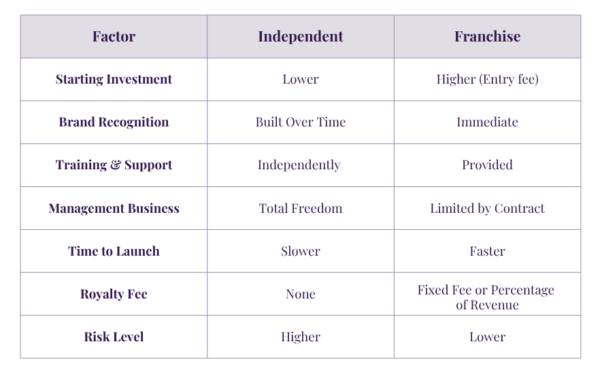
Operating independently gives you greater control over the business and allows you to keep your margins. However, you will have to establish your brand from scratch and manage every aspect of the business yourself.
A franchise generally requires more money upfront through an initial franchise fee and ongoing royalties. In return, you receive access to an established concept, training, and support, although you will have less freedom over how the business operates.
Here are several examples of matchmaking agency franchises operating in France:
Unicis
Unicis is a long-standing matchmaking agency founded in 1973. They have around 100 locations in France and abroad, targeting the general public and offering a satisfaction-or-refund guarantee. Its estimated franchise costs include:
- Entry fee: €20,000 (approx. $21,500)
- Total investment: €30,000 to €40,000 (approx. $32,000 to $43,000)
- Personal contribution: around €13,000 (approx. $14,000)
Twoday
Twoday is a matchmaking agency that targeting a younger, digital-savvy clientele with a lower cost of entry. Its estimated franchise costs include:
- Entry fee: around €10,000 (approx. $10,800)
- Total investment: close to €30,000 (approx. $32,000)
- Personal contribution: around €10,000 (approx. $10,800)
- Monthly royalty: around €350 (approx. $375)
Fidelio
Fidelio has over 40 years of experience and positions itself as a dating coaching network that goes beyond simple matchmaking, with 35 locations. This model suits individuals drawn to comprehensive client support and a structured methodology. Its estimated franchise costs include:
- Entry fee: around €13,000 (approx. $14,000)
- Total investment: €35,000 to €45,000 (approx. $38,000 to $49,000)
- Monthly fee: around €700 (approx. $755)
Kapler
Kapler is more of an interpersonal relationship coaching network, operating through local branches run by independent partners. It stays close to local communities and targets entrepreneurs who want the backing of an established brand along with a high degree of commercial autonomy in their territory.
- Personal investment: starts around €3,900 (approx. $4,200)
Agence Harmonie
Agence Harmonie takes an approach focused on long-term relationships and high-quality client support.
- Minimum personal investment: around €20,000 (approx. $21,500)
Before signing an agreement with any franchise network, ask for the DIP (Document d’Information Précontractuel, or Pre-Contractual Information Document), a legal document that provides key information about the franchisor and the franchise opportunity to help you make an informed decision. Under the loi Doubin, or Doubin Law, French franchisors must provide this document at least 20 days before signing.
The DIP provides information about the market, the franchise network’s finances, and the obligations of both parties.
You are also not limited to self-funding. Potential startup support includes ACRE (Aide à la création ou à la reprise d’entreprise, or Aid for Business Creation or Takeover), which provides a partial exemption from social security contributions for eligible entrepreneurs, subject to specific conditions as of 2026, and ARE/ARCE benefits through France Travail. Other options include interest-free honor loans from Initiative France or Réseau Entreprendre, regional business support programs (formerly NACRE), and standard business bank loans.
Work Out Your Budget
After choosing your business model, you need to map out your expected costs. The amount required will depend largely on how you plan to launch, whether that means operating from home, working online, or joining a franchise.
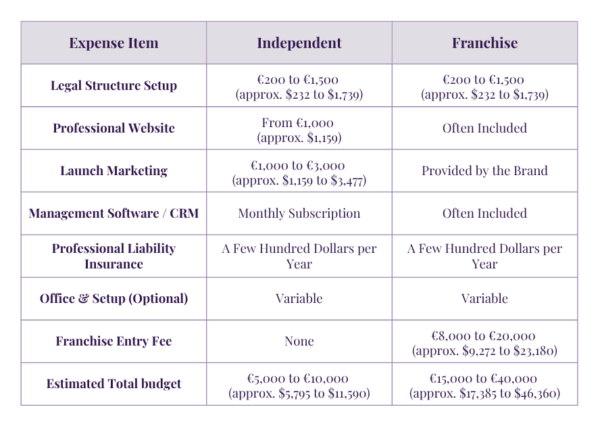
You will also need to account for ongoing expenses once the agency is running. These can include franchise royalties of €350 to €900 (approx. $405 to $1,043) per month, rent if applicable, social contributions, bookkeeping, ongoing marketing, and software subscriptions.
Clients typically pay between €1,200 and €3,000 (approx. $1,390 to $3,477) for a year of support. It is also important to keep 3 to 6 months of working capital available because the business may take time to build its first contracts.
Know How Much Capital You’ll Need
Your startup capital will depend on the structure and scale of the agency. For someone operating independently from home, around €5,000 to €10,000 (approx. $5,795 to $11,590) in starting capital may be enough. Those joining a franchise should plan for a personal contribution of approximately €10,000 to €20,000 (approx. $11,590 to $23,180), representing roughly 30% of the total project cost. The remaining amount is usually covered through a bank loan combined with an honor loan.
Consider Qualifications and Personal Qualities
There is no legal requirement for a diploma or formal qualification to open a matchmaking agency in France. However, training in areas such as psychology, coaching, communication, or business management can help develop the skills needed to work as a matchmaker.
Beyond formal training, personal qualities are particularly important in this profession. Matchmakers need strong listening skills, empathy, and a genuine sales instinct to understand and support their clients.
The role also involves handling sensitive personal information. Verifying details such as a client’s age, marital status, and professional situation therefore plays an important role in maintaining credibility and meeting legal responsibilities.
The Profitability of a Matchmaking Business
There is demand for matchmaking services. Rising rates of singlehood, divorce, and widowhood, together with longer life expectancy, continue to expand the pool of potential clients. At the same time, fatigue with dating apps is encouraging some singles to seek a more personal approach.
Singles seeking serious relationships may be willing to pay for personalized support that screens potential candidates, provides reassurance, and saves time.
The average client pays between €1,200 and €3,000 (approx. $1,343 to $3,356) for a year of support. As a rough benchmark, an established agency can reach €100,000 to €200,000 (approx. $111,880 to $223,760) in annual revenue after one or two years, while the strongest performers can approach €250,000 (approx. $279,700). Most agencies break even within 12 to 18 months. However, there are several factors that can influence the financial performance of the business:
- Positioning
- Service area
- Strength of word of mouth
- How well you convert consultations into signed, renewed contracts
One point is particularly important when setting your prices: avoid underpricing your services simply to fill your calendar. Prices that are too low can devalue the service, attract less committed clients, and weaken the agency’s image.
A smaller number of well-sold contracts delivered with care may be more valuable in the long run, particularly when satisfied clients generate the word-of-mouth referrals that help the business grow.
Originally published by: L’Express Franchise